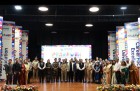
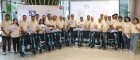
Korean Cultural Centre organized a contemporary art exhibition ‘Transition Zone’ at its center. 5 Korean Artists – Changhoon Lee, Wonho Lee, Yoonjean lee, Minchul Song and Eunsook participated in this exhibition. The exhibition is a manifestation of change and phenomenon and metaphor. The exhibition is on view till 18th of January 2018.
Exhibition ‘Transition zone’ is a contemporary art exhibition and is a manifestation of change and phenomenon and metaphor. At the same time, it is a variety of options and boundaries, a space of buffering, and a process that has the same dailyness as the density of the overcrowded city. Dimensional, multidimensional of points, lines, spaces, and time, which crosses visibility and non-visibility, but which is neither clear nor an uncommon issue. The movement of construction between Korea and India is an opportunity factor to bring the mutation zone as a topic issue. Immediately, we are looking forward to seeing what progressive changes, phenomena, and influences will redefine us in our everyday time. Anyway, a notice of change began. It has already started out of the category of perception.
Changhoon Lee, a conceptual artist made his artwork of beads. He made a triangular structure made up of beads of hand bands. Through his work he tried to express the hierarchy of society and desires. Each bead represented the desires of a human being. He said that as you understand the meaning of life your desire lessens. The same message was given through the triangular shape. At the base level a person has many desires, as he moves up the desire reduces.
This work is a collection of bracelets woven with beads manufactured and processed in India and colorful beads collecting cutbacks of the bracelets in an exhibition floor triangular frame. The audience can possess and possess the beads one by one during the exhibition period, but the shape disappears by scattering by this action. And we hold small Ideal.
Artist WONHO LEE presented his work ‘Floating real estate: home of homeless’. The artist visits major areas in Seoul where homeless people tend to congregate, such as the Seoul Station, the Namdaemun underground passage, and Yeongdeungpo. He then meets homeless people who build their temporary shelters with cardboard boxes, asking about the price. He buys them and installs them in the exhibition space.
What is important in this project is the very process of homeless people converting their house into money by calculating the size of land they occupy and putting the value to it. The possession of a house and its value are usually considered as the share of the middle class. However, homeless people also crave a house while they live without it.
In Floating Real Estate, Lee acquires cardboard houses made by homeless people that live a way of life denied the legal possession of a house in the capitalist society. He then gives an economic value to the houses. This process is an imitation of a real estate investment technique. Nevertheless, the process of valuing the cardboard houses where homeless people evaluate their home is differentiated from the ordinary assessment of a house in the capitalist society. For homeless people, the temporary shelters made of cardboard boxes are connected to the essential values of the house, such as privacy, safety, and insulation at the least. The values they put on their space are instinctive and essential. They are deprived of the value of ‘surplus,’ which is the value that is added to the house as a commodity in the capitalist society. Through this process that reveals the desire implicit in the house, Lee discloses the naked face of the house and indicates its social position.
Artist Minchul Song In this exhibition, he showed <half mirror - Words of water> using a mirror and a checkerboard and <equivalent other circle> to calculate and rearrange the area of each different circle using a round target. Minchul Song work to visualize things that we are interested in things that exist but we cannot experience, such as the compatibility of handling various media, the way of forming the whole, and the hypotheses based on propositions. (Half mirror - Words of water_birch plywood, mirror, water_105 x 112.5 x 79cm_2017)
Artists EUNSOOK organizes elements of form through meaningful life experiences and expresses realistic viewpoints in various ways. Through this exhibition, it induces the re-recognition of the magical thinking inherent in the space and suggests a turning point of thinking. The inner thoughts that mobilize to comfort the unknown forces in some of the situations we face, the human being chooses a useful way, not the correct way. We cannot communicate directly with reality, and we cannot be sure that reality really exists. I only experience reality through the filter of consciousness. That is, the brain is composed only of subjective information through the information of sensory organs. To understand the ultimate nature of reality, it is necessary to see how the mind creates reality.
Yoonjean Lee's work is the same kind as the neutral approach to the object, despite typological methodology and external similarity to take objects of similar shape, it is a matter of German contemporary photography I have probably placed a distance.